
A carbon number you can defend — and a pathway to cut it.
A GHG inventory (greenhouse-gas footprint across Scopes 1, 2 and 3) built to the GHG Protocol, a decarbonisation pathway a board can approve, and climate disclosure aligned to IFRS S2, which incorporates the TCFD recommendations — every figure traceable to its activity data.
Your emissions number used to be an estimate. Now it gets tested.
Emissions and energy sit inside the KPIs India's disclosure regime increasingly subjects to independent scrutiny — and customers, lenders and boards are asking for the working, not the summary. Three pressures land at once.
Checked, not asserted.
Greenhouse gases and energy are attributes of BRSR Core — the subset of India's mandated disclosure subject to independent assessment or assurance. A footprint that can't be traced to activity data is where that stalls.
Your customers count you.
Your emissions are someone else's Scope 3. Customers and lenders with their own targets increasingly ask suppliers for credible numbers — and drop the ones who can't show them.
Energy is money.
Behind every tonne of CO₂e is fuel and electricity you paid for. A footprint you actually understand is also a map of operating cost — decarbonisation done properly is an efficiency programme.
From fuel bills and activity data to a board-approvable pathway.
We build the inventory, set the trajectory, and prepare the disclosure — and you keep the calculation trail behind every figure, so next year is an update, not a rebuild.
Build the inventory
Scopes 1, 2 and 3 to the GHG Protocol — boundaries set, factors sourced and versioned, every line traced to activity data.
Set the trajectory
A baseline your board can sign, and reduction targets grounded in what your operations can actually deliver.
Plan the reductions
Interventions ranked by abatement and cost — energy, process and procurement levers in one sequenced pathway.
Report it credibly
Climate disclosure aligned to IFRS S2 (incorporating the TCFD recommendations), consistent with your BRSR — written for the reader who checks.
The hard part is the value chain. We have done all fifteen categories.
Scope 3 is where most of the footprint hides — and where most inventories stop. We have calculated Scope 3 across all fifteen categories — the full value-chain footprint — for an energy company: purchased and capital goods, transport, waste, business travel, use of sold products and end-of-life, each traced to activity data.
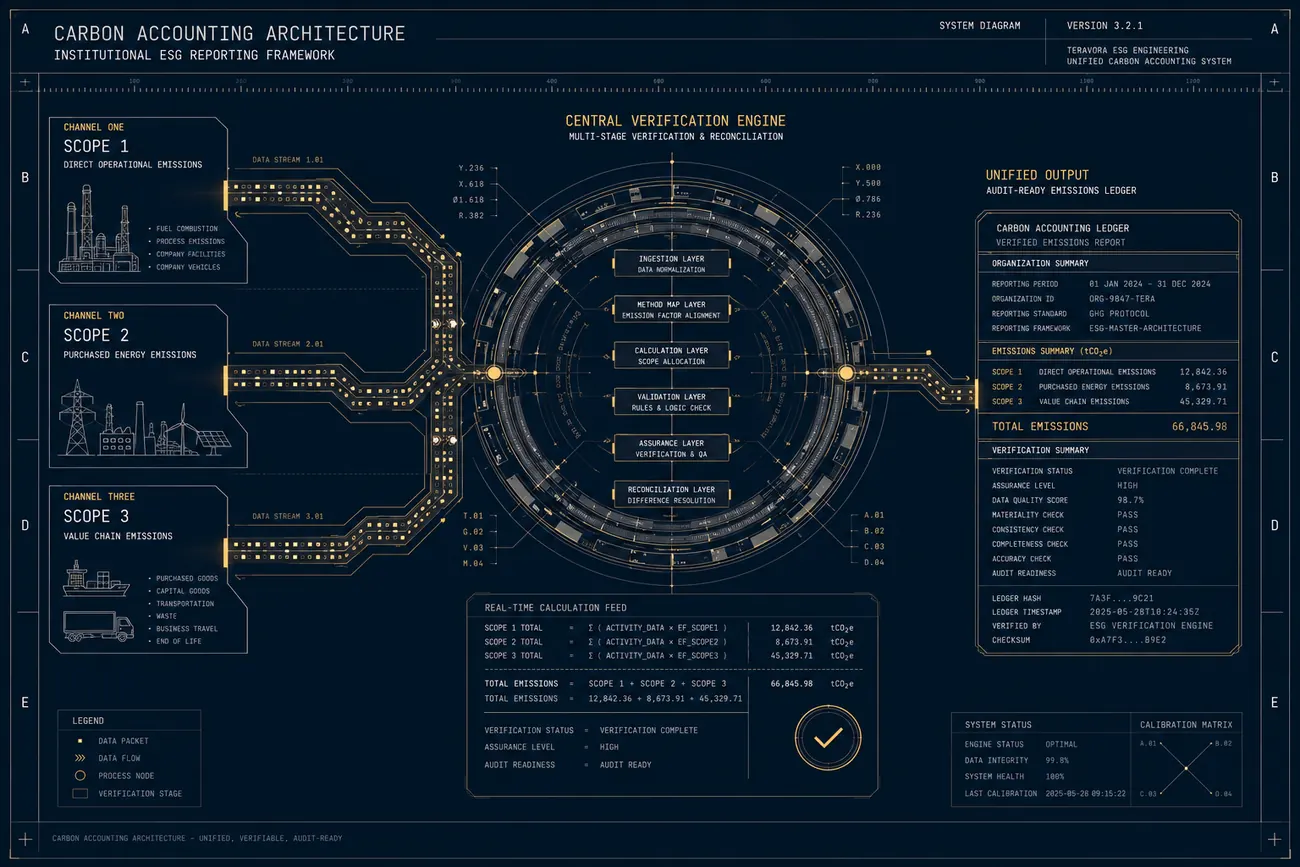
Every tonne we report carries its activity data, its factor and its source.
The inventory is mastered against the standards that govern it, so the same numbers serve your disclosure, your customers and your lenders:
A typical engagement takes you from source data to a complete Scopes 1, 2 and 3 inventory and a costed reduction pathway across a single reporting cycle.
Every tonne on the page
traces to an activity, source and calculation.
Behind the inventory is the boiler, the fleet and the grid your figures describe. A credible footprint starts at the meter — not in a spreadsheet template.
Built for the teams a carbon number lands on.
Manufacturers & operators
Energy-intensive operations that need a defensible footprint and a reduction pathway that respects how the plant actually runs.
Request a Proposal →Listed companies
Carrying GHG and energy KPIs into scope for assessment or assurance, and answering climate questions from the board and investors.
Request a Proposal →Suppliers with customer asks
Asked for emissions data by customers and lenders with their own targets. We scope a proportionate, credible response.
Request a Proposal →Bring us your activity data.
Tell us your operations and what your buyers or board are asking for. A specialist scopes a proposal — a real person, not a form receipt.